





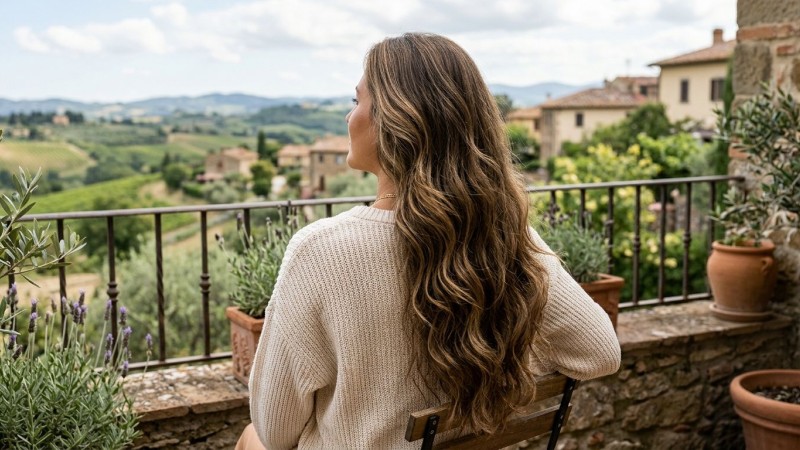
Imagine having long, thick, voluminous hair. You browse beautiful hairstyles, save pictures for inspiration and imagine how your hair might look with a little extra length and fullness. But there is one problem: your natural hair is thin, the ends look sparse, and you worry that adding more volume might make the result look unnatural.
This is one of the reasons many women hesitate when considering hair extensions. They do not want hair that looks excessively thick at the bottom while remaining thin at the top. They do not want a noticeable line between their natural hair and the added strands. They simply want their hair to look the way they have always imagined it: fuller, beautiful and naturally flowing.
The good news is that achieving this look does not depend on adding as much hair as possible. What matters much more is choosing the right length, colour, texture and amount to complement your natural hair.
In this article, we will explore how to achieve more volume with natural hair extensions, which mistakes can affect the final result and what to consider before making your choice.
1. Why Does Thin Hair Look Even Sparser at the Ends?
One of the most common concerns with thin hair is the difference between the volume at the roots and the density along the lengths. The hair may look relatively full at the top, but the closer you get to the ends, the thinner it becomes.
This is especially noticeable with long hair. Over time, the ends may become damaged, break or simply look less dense than the rest of the hair. As a result, even if the roots have a reasonable amount of volume, the overall hairstyle may still look less full than desired.
This is where hair extensions can help. They allow you to add hair where extra density is needed, making the lengths look more even.
However, it is important to distinguish between adding volume and adding length. If you like your current length but want your ends to look fuller, you do not necessarily need very long extensions. Sometimes, hair that is closer to your natural length creates a much more harmonious result.
2. More Hair Does Not Necessarily Mean a Better Result
When looking at pictures of long, voluminous hair, it is easy to be tempted by maximum length and a large amount of extensions. This may look impressive in a photograph, but the actual result depends on the characteristics of your natural hair.
If your hair is very fine and sparse, adding too much hair can create a noticeable contrast. The lower part of the hairstyle may become significantly thicker while the top remains thin. If the transition is not carefully considered, the extensions may be visible even when their colour matches your natural hair.
That is why it is worth asking yourself a simple question: do you mainly want much longer hair, or do you want your hair to finally look full along its entire length?
These are two different goals, and they do not always require the same solution.
If your main priority is fullness, consider the length and amount of hair that will blend best with your own. If you also want a significant increase in length, you need to think about how to create a gradual transition between the upper and lower sections of your hairstyle.
The most beautiful result is not necessarily the one with the most hair. It is the one in which the added strands look like a natural part of the overall hairstyle.
3. How to Choose the Right Hair Extension Length
Length is one of the most important factors in achieving a natural look. The greater the difference between your natural hair and the extensions, the more carefully the final result needs to be planned.
Imagine, for example, that your hair falls just below your shoulders and you want it to reach your waist. This is a significant change and may require extra attention to the density of your natural ends, the distribution of the added hair and the final shape of the hairstyle.
On the other hand, if your hair is already relatively long but looks sparse towards the bottom, adding a moderate amount of hair at a similar length may create a fuller and more natural finish.
When choosing extensions, consider:
-
Your current hair length: How much longer do you want your hair to be?
-
The density of your ends: Will your natural hair blend well with the desired length?
-
Your usual hairstyle: Straight hair and soft waves create different visual effects.
-
Your everyday style: Do you prefer a natural look, noticeable volume or long hair for special occasions?
Do not choose a length based only on how the extensions look on their own. Imagine how they will look when combined with your natural hair.
4. Colour Can Make All the Difference
You may have chosen high-quality natural hair extensions and the right length, but if the colour does not match your natural hair well, the result may still look artificial.
This is because hair does not always have the same shade from roots to ends. With coloured hair, highlights, balayage or ombre, the roots may be darker while the lengths contain several different tones.
In these cases, choosing a colour based only on your roots is not enough. You also need to consider the mid-lengths and ends, because this is where the extensions will blend with your natural hair.
For example, if your roots are dark blonde but your ends transition into lighter blonde shades, single-colour extensions may create a visible difference. A more suitable combination of shades can help create a smoother transition.
The same applies to brunettes. Even hair that appears to be a uniform dark colour may contain different undertones that become noticeable in natural light.
Whenever possible, compare colours in daylight and seek advice if you are choosing between two similar shades. The right colour match can often make the difference between hair that looks added and a hairstyle that looks completely natural.
5. What Role Does Hair Texture Play?
Colour is not the only factor that determines whether extensions blend well with your natural hair. Texture also plays an important role.
If your hair is naturally straight, choosing extensions with a similar texture may make styling easier. If your hair is wavy, differences between your natural strands and the added hair may become more noticeable when your hair dries naturally.
This does not mean you should avoid extensions if you have wavy or curly hair. It simply means that you should make your choice based on how you usually wear your hair.
Think about how your hair looks most of the time: straight, with soft waves or with natural curls. Choose an option that allows you to achieve your desired look without having to spend a long time styling it every day.
Hair extensions made from natural hair can offer more styling possibilities, but the treatments and styling methods suitable for use depend on the specific product. Always follow the product's care and heat-styling instructions.
6. Which Mistakes Most Often Reveal That You Are Wearing Extensions?
A natural result depends on more than the quality of the added hair. The way it blends with your own hair also matters.
Here are some situations worth paying attention to.
Ends that are too thick. If your natural hair is very fine but the extensions add significantly more density, the hairstyle may look unbalanced. The amount of added hair should be chosen according to your natural hair density.
A visible line between the two lengths. When your natural hair is significantly shorter, the transition may be noticeable. Choosing the right length and styling the hair appropriately can help create a more harmonious look.
A colour mismatch. Even a small difference may become visible when your hair moves or is exposed to bright light.
Incorrect extension placement. If the attachment points cannot be adequately concealed by your natural hair, they may be visible with certain hairstyles. Choosing an application method requires particular care when the natural hair is thin.
Excessive weight. Wanting maximum volume should never come at the expense of comfort or the condition of your natural hair. Extensions that are too heavy may cause pulling and damage.
The best approach is to plan the overall look rather than choosing each feature separately.
7. How to Choose Extensions That Suit Your Lifestyle
Before making a choice, think not only about how you want your hair to look, but also about how you will wear it every day.
If you usually wear your hair down with minimal styling, even volume and natural movement may be your priorities. If you frequently wear ponytails or updos, pay particular attention to the attachment method and whether the attachment points can remain concealed.
Consider how much time you are willing to spend on maintenance, too. Extensions require careful brushing, suitable haircare and attention when styling. The exact requirements depend on the type of extensions and the application method.
If you are considering extensions for the first time, you do not need to start with the most dramatic change. A more gradual approach can help you discover which length and density you prefer and how comfortable you feel with your new look.
If your hair is very thin, visibly thinning or experiencing active hair loss, its condition should be assessed first. Extensions do not treat hair loss, and excessive or unsuitable weight may make the problem worse.
8. How to Maintain the Beautiful, Natural Look of Hair Extensions
Once you have found a suitable option, proper care helps your hair look good and makes it easier to style.
Brush gently, avoiding sudden movements and pulling. Start at the ends and gradually work your way upwards, supporting the hair when necessary.
Use products suitable for your specific type of extensions. Excessive amounts of oils, masks or styling products may weigh the hair down and reduce its volume. Avoid applying products to attachment areas unless the instructions for your particular application method allow it.
When heat styling, use an appropriate heat protectant and follow the product's temperature recommendations. Do not automatically assume that every type of natural hair can be treated in exactly the same way.
If you wear professionally applied extensions, follow your stylist's maintenance recommendations. If you experience pulling, pain or discomfort, do not delay having the application checked.
Natural Volume Starts with the Right Choice
Having thin hair does not mean you have to give up your dream of a fuller, longer hairstyle. However, it is important to choose a solution that suits the characteristics of your natural hair and the look you want to achieve.
When choosing natural hair extensions, pay attention to length, colour, texture, quantity and the appropriate application method. These factors work together to create a harmonious result in which the added hair blends naturally with your own.
Sometimes, you do not need a dramatic increase in length or maximum volume. Adding the right amount of fullness in the right places may be enough to make your hairstyle look more complete.
Explore the natural hair extensions available at HairCompany and choose an option that suits your style, your desired result and the characteristics of your natural hair. If you are unsure, consulting a specialist can help you find the right balance between extra volume, a natural appearance and wearing comfort.
Write a Comment